
Why this blog?
Most AI pilots prove that a model can work. Far fewer become dependable capabilities that deliver value at scale. The gap is rarely the model alone, it is the surrounding data foundation, governance, evaluation, operations and business ownership. Production AI requires these capabilities to work together, from the first hypothesis to continuous value realization.
A practical approach to building reliable enterprise Al capabilities
Production Demands More Than a Working Pilot
A successful prototype proves the idea, reliable enterprise value requires trusted data, governance, evaluation, operations and measurable outcomes.
The first wave of enterprise AI was defined by experimentation. Organizations launched copilots, knowledge assistants, summarization tools, natural language interfaces, predictive models, and automated workflows. Many pilots proved that the technology could work. Production requires a higher standard: an AI system must operate reliably, securely, economically, and repeatedly at enterprise scale.
The central question is no longer whether an AI solution can be built. It is whether an experiment can become a trusted production capability. Factspan views this as a Data and AI challenge rather than an AI only challenge. Production outcomes depend on the data foundation, governance model, application architecture, operating processes, evaluation controls, and business objectives surrounding the AI system.
The Production Gap
A pilot is designed to answer one question: Does the idea work? A production system must answer several others.
- Is the underlying data trusted?
- Can the system access the right context securely?
- Can outputs be evaluated continuously?
- Can the application operate reliably at scale?
- Can quality, cost, latency, and usage be monitored?
- Can people intervene when necessary?
- Can the solution integrate into existing workflows?
- Can the business measure the value created?
- Can the system evolve as models and requirements change?
Factspan brings these capabilities together across the journey from AI discovery and experimentation through production deployment, combining cloud data engineering, data governance, data science, AI engineering, MLOps, LLMOps, and enterprise AI capabilities.
Five Capabilities for Production AI
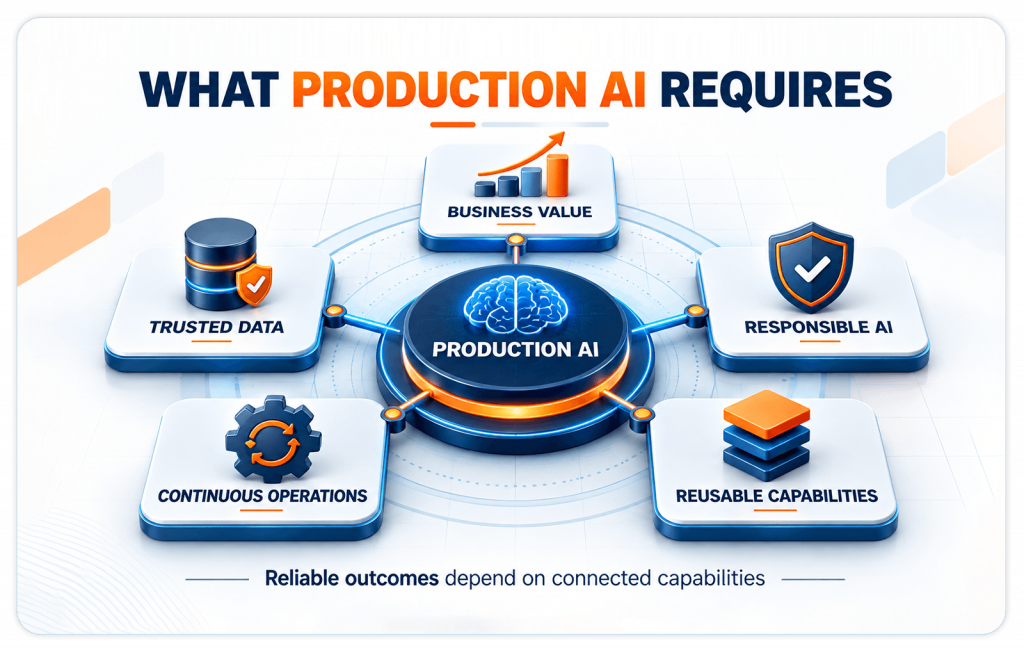
Start with Business Value
AI programmes often begin with technology questions about models, agents, or vector databases. These decisions should follow a clear business definition. A production initiative needs a documented business problem, value hypothesis, target user group, success metrics, operational KPIs, risk boundaries, and adoption criteria.
For example, an AI customer service assistant should be assessed through resolution time, first contact resolution, agent productivity, escalation rates, customer experience, and cost per interaction, not model accuracy alone. Factspan uses a hypothesis driven approach to connect AI performance with business performance.
Build Trusted Data Foundations
AI is only as reliable as the information it can access. Enterprise data is distributed across warehouses, data lakes, operational systems, documents, APIs, applications, and third party sources. Production readiness depends on data quality, integration, metadata, lineage, access control, privacy, data contracts, semantic consistency, and unstructured data management.
Factspan combines cloud data engineering and data governance to establish the foundation required for scalable AI. A typical AI ready data foundation includes ingestion, transformation, data quality, metadata, governance, data products, and AI consumption. The objective is trusted, contextual, accessible data.
Engineer Trust and Responsible Use
Production AI must produce outputs that are accurate, grounded, relevant, explainable, safe, compliant, consistent, and appropriate for the business context. This is especially important for retrieval augmented generation and agentic applications.
Production architectures should include prompt and response evaluation, groundedness checks, hallucination detection, bias and safety testing, auditability, access controls, guardrails, and continuous quality monitoring. Human review should be defined wherever the risk or business context requires it. Factspan extends governance into AI systems through LLM evaluation and responsible AI practices.
Operate AI Continuously
Building an AI application is only the beginning. Once deployed, the system must be monitored in real operating conditions. Traditional machine learning operations track model performance, data drift, feature drift, latency, infrastructure health, and retraining requirements. AI applications add prompt quality, response quality, retrieval quality, token consumption, model cost, agent behaviour, tool usage, and failure patterns.
This expands MLOps into LLMOps and broader AI operations. A production operating model should continuously assess whether the system is working, meeting quality standards, operating within cost and latency limits, behaving as intended, and delivering business value. Factspan supports deployment, monitoring, evaluation, lifecycle management, and optimisation across AI workloads.
Build Reusable Capabilities
Scaling AI use cases one at a time creates duplicated engineering effort, fragmented architectures, repeated governance work, inconsistent evaluation, higher operating costs, and longer deployment cycles. A more sustainable approach is to build reusable AI foundations, retrieval patterns, evaluation frameworks, governance controls, agent architectures, persona based copilots, shared observability, and common data and knowledge services.
Factspan’s FLUX portfolio supports AI experimentation, evaluation, deployment, and reuse through capabilities such as AI Studio, FactiLLM Copilot, LLM evaluation, and persona based copilots. The strategic shift is from one pilot producing one application to one foundation supporting multiple production capabilities.
The Connected AI Lifecycle
Production AI is not a linear technology implementation. It is a connected chain:
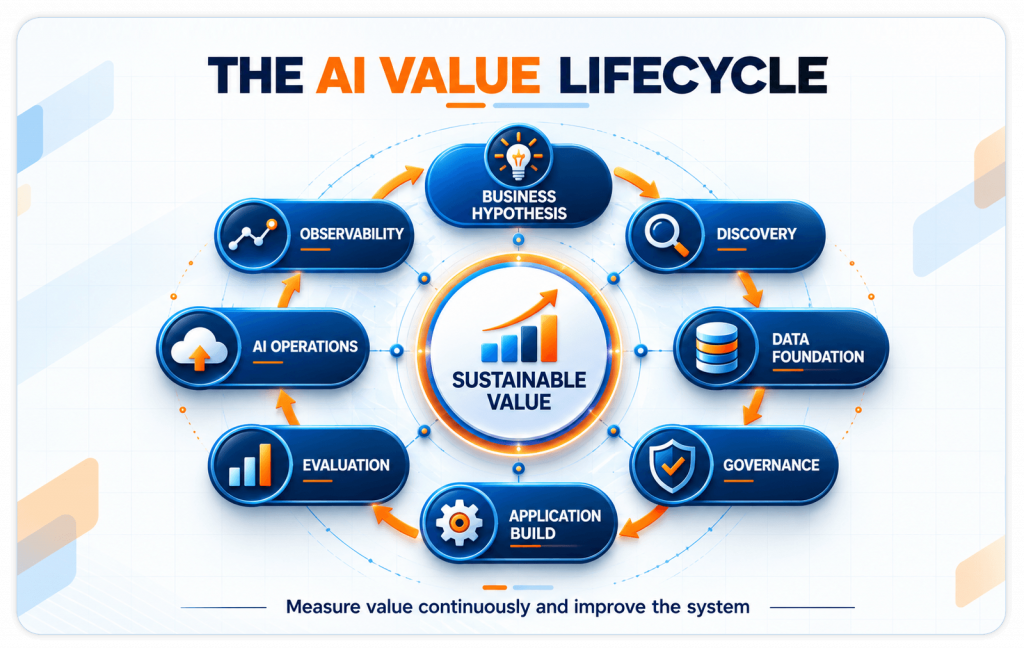
Each capability reinforces the next. Better data improves quality. Better governance improves trust. Better evaluation improves readiness. Better observability improves reliability. Better cost management improves scalability. Measurable business outcomes determine whether an AI capability deserves further investment.
A Practical 16 Week Path
A production readiness programme can be organised across four phases. The phases may overlap, but none should be treated as optional.
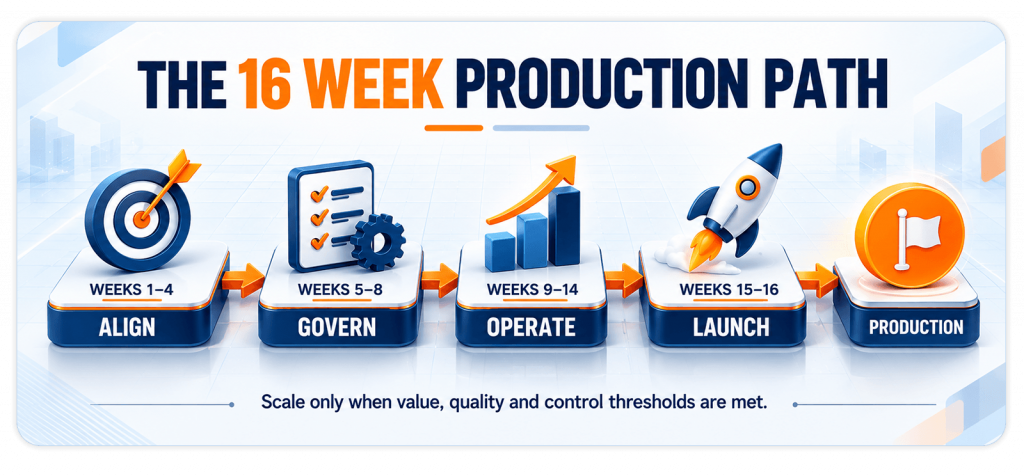
Weeks 1 to 4
- Inventory existing AI initiatives
- Define business KPIs and value thresholds
- Map data dependencies
- Assess governance readiness
- Assign executive ownership
Weeks 5 to 8
- Establish data governance controls
- Build evaluation and observability pipelines
- Implement quality, safety, and groundedness checks
- Begin model development with quality gates
Weeks 9 to 14
- Deploy AI operations capabilities
- Establish model versioning and monitoring
- Automate retraining where required
- Launch workforce enablement
- Define escalation and review procedures
- Complete security and regulatory reviews
Weeks 15 to 16
- Launch with a controlled user group
- Monitor business and technical KPIs
- Validate the value hypothesis
- Scale only when quality, risk, adoption, and value thresholds are met
Think in Capabilities
As AI programmes mature, organisations should ask what reusable capability will help scale their highest value use cases, rather than selecting isolated use cases one at a time.
| Business need | Production capability |
| Enterprise knowledge access | Trusted retrieval and knowledge services |
| Employee productivity | Persona based copilots |
| Workflow automation | Agent orchestration |
| Data driven decisions | AI powered analytics |
| Application quality | LLM evaluation |
| Reliable AI operations | MLOps and LLMOps |
| Risk and compliance | Responsible AI governance |
| AI cost management | Model and workload optimisation |
Preparing for Agentic AI
Enterprise AI is moving beyond standalone assistants and copilots. Organisations are exploring systems that reason across multiple steps, retrieve information dynamically, use enterprise tools, execute workflows, coordinate with other agents, and escalate decisions when required.
Greater autonomy creates greater responsibility. Every agentic system needs clear answers about independent decisions, approval points, information access, evaluation, monitoring, failure handling, auditability, and cost control. Organisations best positioned for this phase will have trusted data, clear governance, reliable engineering, continuous evaluation, and mature operating controls.
The Enterprise Advantage
Enterprise AI success is not measured by how quickly a prototype is built. It is measured by how reliably that capability creates sustainable business value.
- From models to complete systems
- From isolated pilots to reusable platforms
- From experimentation to operational discipline
- From AI outputs to business outcomes
- From individual use cases to shared capabilities
Factspan brings together data engineering, governance, AI development, evaluation, observability, and production operations to help organisations build AI capabilities that can operate, adapt, and scale responsibly.
Ready to move AI from experimentation to production?
Connect with Factspan to build the data, governance and operating foundations required to scale AI with confidence.


Building Governed Prior-Authorization Intelligence...

Production Readiness for Enterprise AI...

Engineering AI Token Optimization...

Mathematical Optimization for Enterprise Decision ...

PowerCenter to IDMC: A Practical Migration Playboo...

AI Co-Engineer for the Data Engineering Lifecycle...

Building Scalable Data Pipelines with Alteryx and ...