
Why this blog?
Interoperability makes clinical information easier to exchange, but not necessarily easier to use. When evidence remains fragmented across systems, reviewers still spend time searching, interpreting and validating the complete clinical picture manually.
A governed clinical data foundation can connect structured records, clinical documents and policy criteria in one review workflow, improving evidence traceability, reviewer confidence and responsible AI-assisted decision-making.
How payers can bring structured clinical data, unstructured evidence, policy content, and AI-assisted review into one governed decision environment built on Databricks.
Prior authorization is becoming a data problem
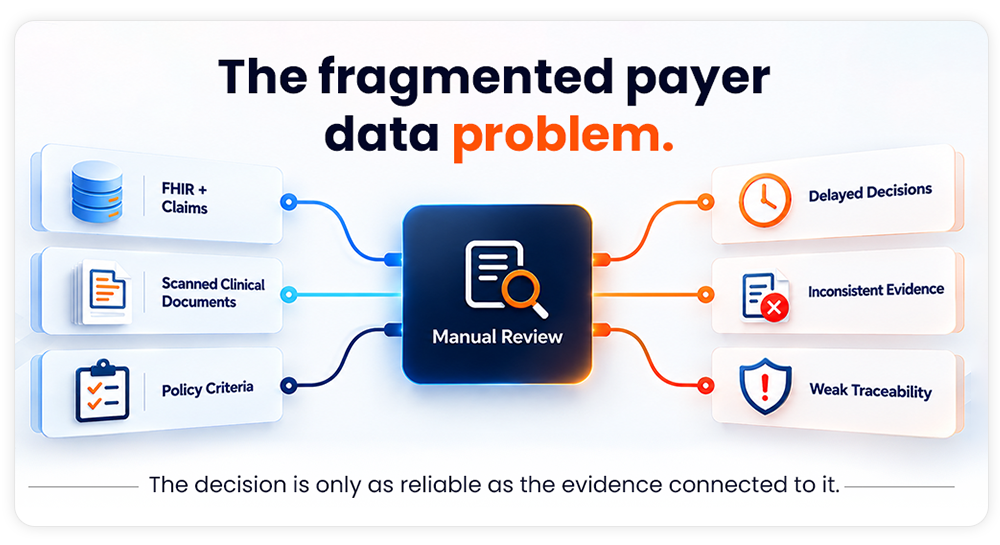
Health plans are expected to make timely, well-supported prior-authorization decisions using information that rarely exists in one place. A single review may depend on claims records, FHIR payloads, physician notes, pathology reports, scanned faxes, prior-authorization packets, and clinical policies.
The operational challenge is not simply the volume of information. It is the distance between the evidence and the decision. Structured data may sit in one system, scanned documents in another, policy criteria in a third, and the final review workspace somewhere else. Clinicians and operations teams are then forced to assemble the clinical picture manually.
This creates a familiar set of problems: review teams spend time searching for evidence, important context remains difficult to query, missing information is discovered late, and AI-generated recommendations can be difficult to verify when they are not connected to their sources.
Flux Health on Databricks
To solve this challenge, Factspan developed Flux Health, an enterprise-grade clinical intelligence and autonomous prior authorization platform built 100% natively on the Databricks Data Intelligence Platform.
Flux Health bridges the gap between dark unstructured intake and structured clinical feeds by synthesizing all data into a canonical FHIR R4 Lakehouse data model within Databricks Unity Catalog. By coupling Mosaic AI Vector Search, Agent Bricks, and Databricks Lakebase, Flux Health enables health plans to automate evidence-based prior-authorization reviews and close HEDIS care gaps in real time, entirely within the payer’s governed cloud boundary.
Interoperability is necessary, but it is not enough
Regulatory and operational pressure is accelerating the move toward more timely and interoperable prior-authorization workflows. CMS-0057-F is part of that shift, introducing requirements related to electronic information exchange and prior-authorization processes for applicable payers. The broader direction is clear: health plans need more accessible, timely, and transparent clinical information.
But exposing information through an API does not, by itself, create clinical intelligence. A payer can improve electronic exchange and still struggle if critical evidence remains trapped in scanned documents, clinical terminology is inconsistent, and policy rules are disconnected from member information.
The real requirement is a connected decision environment, one that can bring together the member record, clinical evidence, and applicable policy while preserving governance and reviewability.
The three data layers behind a clinical decision
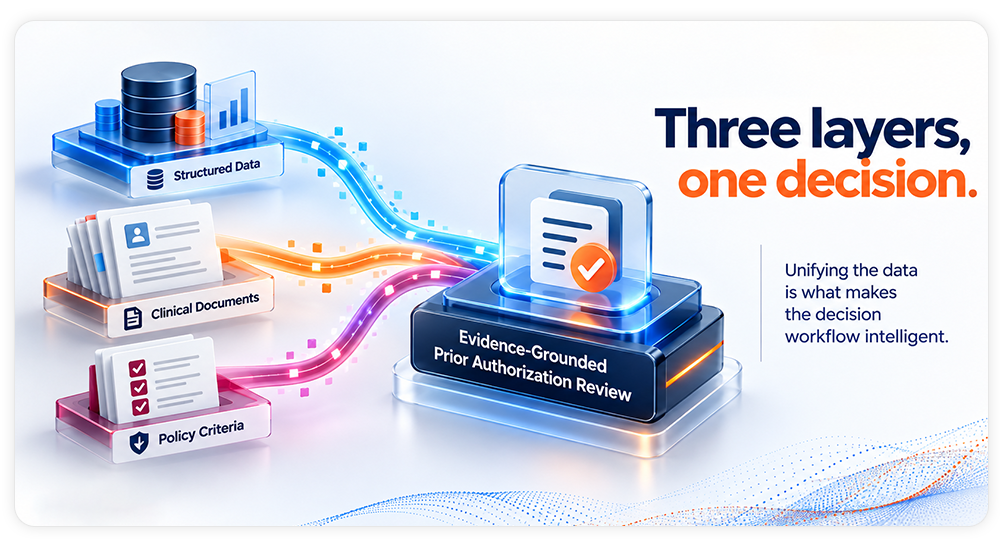
A reliable prior-authorization workflow must work across three distinct data domains. Each serves a different purpose, but the decision depends on all of them being available together.
| Data domain | Role in the decision |
|---|---|
| Structured clinical data | FHIR feeds, claims, encounters, procedures, observations, and other structured events establish the member history. |
| Unstructured clinical evidence | Faxes, PDFs, physician notes, pathology reports, and intake packets provide detailed clinical context. |
| Policy and criteria content | Coverage guidelines, clinical policies, and question sets define the criteria against which evidence is evaluated. |
A reliable prior-authorization workflow must work across three distinct data domains. Each serves a different purpose, but the decision depends on all of them being available together.
Why point solutions leave the hardest problem unsolved
Many payer environments have already invested in separate tools for data engineering, document extraction, analytics, policy management, and clinical operations. The problem is that these capabilities often operate on different data copies and follow different control models.
- Clinical document extraction may produce facts that are not written back to the member record.
- Analytics and operational applications may use different versions of the same clinical data.
- Reviewers may still move between systems to find documents, policies, and patient history.
- AI outputs may sound plausible without showing the exact evidence used.
- Sensitive clinical data may cross unnecessary system or vendor boundaries.
The result is not a lack of technology. It is a lack of continuity between ingestion, interpretation, decisioning, and action.
A governed clinical foundation
The more durable approach is to create a governed clinical foundation in which structured feeds and unstructured documents can be processed into a common, FHIR-aligned model. This gives downstream workflows a consistent representation of the member’s clinical history instead of forcing every application to interpret source data independently.
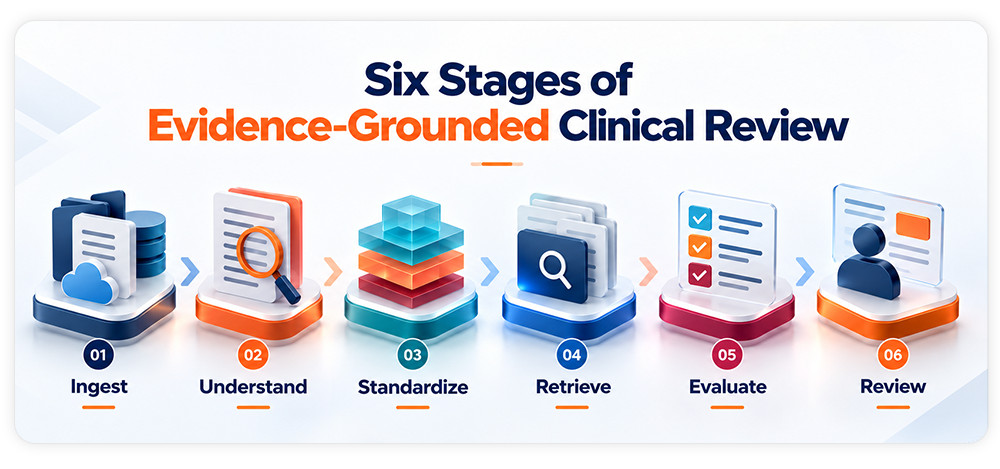
A practical architecture follows a connected path:
- Land structured and unstructured data in Unity Catalog Volumes and governed Delta tables.
- Process documents through OCR, de-identification, segmentation, and clinical entity extraction.
- Map extracted facts and structured events into a canonical clinical model.
- Retrieve relevant policy content using governed search and retrieval.
- Evaluate the case against defined criteria and question sets.
- Serve the results through an operational workspace where reviewers can verify, approve, or pend the case.
This is where the platform matters. Databricks provides the foundation for data engineering, governance, AI and machine learning, operational serving through Lakebase, and application development. Unity Catalog Volumes provide a governed location for raw scanned faxes, pathology PDFs, and medical policies alongside structured Delta tables, with unified access controls and lineage. The value comes from connecting these capabilities into one clinical workflow rather than treating them as isolated features.
For policy retrieval and governed AI orchestration, Mosaic AI Vector Search can support Delta-Sync HNSW indexing over governed policy chunks, including eviCore and CMS clinical policy content where those sources are part of the deployment. Agent Bricks can be used alongside these services to support the configured clinical workflow. Databricks Model Serving can host approved foundation models such as Claude 3.5 Sonnet or Llama 3.1, while MLflow Tracing can capture step-level execution for auditable CMS-0057-F decision rationales. These model and policy configurations should be aligned with the health plan’s approved deployment.
Lakebase also supports the operational layer: it can provide sub-100-millisecond reads for the clinical user interface and support controlled bidirectional write-backs when reviewers validate narratives or close care gaps. Clinical reviewers, including nurses and medical directors, access the workflow through Databricks Apps via enterprise SSO such as SAML or Okta, rather than directly through notebooks or SQL editors.
The trust layer: AI must show its work
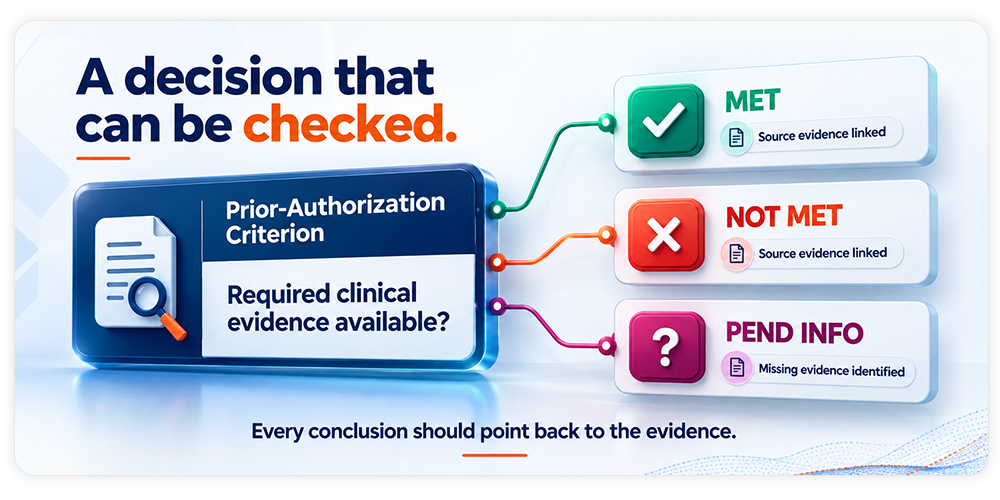
Clinical AI cannot be judged only by whether its answer sounds correct. In a payer workflow, the reviewer must be able to understand how the answer was reached and what evidence supports it.
That means the system should identify the clinical facts it used, connect those facts to source text or document pages, show which criteria are met or not met, identify missing information, and preserve a reviewable history of the decision. When the evidence is incomplete, the correct action is not to force a conclusion. It is to pend the case and generate a missing-evidence checklist. The workflow does not auto-deny a case solely because required evidence is unavailable.
This approach changes the role of AI. It is not replacing clinical judgment with an opaque answer. It is reducing the time required to find, organize, and verify the information needed for clinical judgment.
One clinical foundation, more than one payer workflow
The value of a governed clinical foundation extends beyond a single prior-authorization decision. A scanned fax, physician note, or clinical packet processed for medical-necessity review can also provide evidence for quality measures and care-gap workflows, provided that the evidence is normalized, governed, and linked back to its source.
In traditional payer silos, evidence used for a prior-authorization case may be reviewed and then remain unavailable to quality teams. Flux Health is designed to preserve that evidence in a canonical clinical model so the same intake can support connected workflows. Flux Auth can evaluate medical necessity against approved policy criteria, while Flux Stars can use the resulting clinical facts to identify and support HEDIS quality-gap closure. Flux Intake provides the document-intelligence layer that extracts, structures, and grounds the evidence.
This dual-use model reduces the need to process the same clinical document separately for prior authorization, quality analytics, and care management. The evidence can move from intake to review to quality action while preserving its source, governance controls, and decision history. The specific measures and workflows remain subject to the health plan’s approved deployment and clinical configuration.
What the evaluation demonstrated
During an enterprise evaluation using representative payer cohorts and complex oncology prior-authorization scenarios, Flux Health demonstrated the following results:
| Evaluation area | Result |
|---|---|
| More than 80% reduction, from 18 minutes to under 2.5 minutes per case. | |
| Traceability | 100% traceability across evaluated criteria checks, with citations to source documents and policy sections. |
| Clinical data foundation | Structured FHIR feeds and scanned clinical documents resolved into a common canonical model. |
| Operational search | Member 360 queries delivered in under 150 milliseconds in the evaluated environment. |
| Data boundary | Models, vector indexes, and storage operated within the evaluated governed cloud environment. |
These results illustrate the value of connecting clinical data engineering, document intelligence, policy retrieval, AI-assisted review, and operational serving in one architecture. They also reinforce an important principle: speed is meaningful only when the resulting decision remains reviewable and defensible.
A practical path to governed clinical intelligence
For payer organizations, modernizing prior authorization is not only a workflow-automation exercise. It requires a dependable clinical data foundation that can connect structured records, unstructured evidence, policy content, governance controls, and operational applications.
Factspan Flux Health is an enterprise clinical solution Built on Databricks. For Databricks Marketplace and partner-led healthcare communications, the platform foundation comes first: the Databricks Data Intelligence Platform provides the governed data, AI, retrieval, operational serving, and application layer, while Flux Health applies that foundation to payer clinical intelligence. It uses Unity Catalog for governance and lineage, Mosaic AI capabilities for governed AI workflows, and Databricks Apps for application delivery. It brings these capabilities together to help health plans unify FHIR data and clinical documents, synthesize evidence into a canonical clinical model, retrieve relevant policy guidance, and support prior-authorization and quality workflows with source-linked outputs. For healthcare context, see Databricks Healthcare and Life Sciences and Factspan’s Life Sciences and Healthcare capabilities.
The approach is built around a simple principle: clinical AI should help teams move faster without making decisions harder to verify. Flux Health is an in-tenant solution accelerator deployed inside the health plan’s own cloud perimeter, including AWS or Azure VPC environments. No patient PHI or prompt data leaves the customer’s tenant for external vendor APIs. Data, models, vector indexes, and outputs remain within the governed environment, subject to the customer’s approved deployment and security configuration.
Explore Flux Health and Databricks for governed prior-authorization intelligence:
Schedule a Live Demonstration on Databricks – Contact Factspan
Explore Factspan Healthcare Solutions – Life Sciences and Healthcare
Ready to move AI beyond the pilot?
Talk to Factspan about building the foundations required to scale AI reliably and responsibly.


Production Readiness for Enterprise AI...

Engineering AI Token Optimization...

Mathematical Optimization for Enterprise Decision ...

PowerCenter to IDMC: A Practical Migration Playboo...

AI Co-Engineer for the Data Engineering Lifecycle...

Building Scalable Data Pipelines with Alteryx and ...