
Five capabilities for reliable Al at scale
Why this blog?
Many AI pilots prove that a model can work, but far fewer become reliable capabilities that deliver value at scale. The challenge lies in the foundations around the model, data, governance, evaluation, operations and business ownership. Production AI requires these capabilities to work together across the entire lifecycle. This framework shows enterprises how to move from isolated experiments to scalable AI capabilities.
Why 74% of Companies Struggle to Achieve Measurable Value at Scale and the Five Capabilities That Set Winners Apart
In 2024, a financial services firm launched 12 separate generative AI pilots across different business units. Each was technically successful. The problem: none reached production.
Siloed data governance meant compliance couldn’t sign off. Fragmented technology stacks created security nightmares. No clear business value metrics meant leadership wouldn’t fund expansion. Eighteen months later, the initiative was quietly shelved.
This is not an outlier. It’s the norm. According to BCG’s 2025 [1] research, 74% of companies struggle to achieve measurable value from AI investments.
Key Finding: Organizations with mature governance frameworks, unified data platforms, and clear value metrics are 3.2x more likely to sustain AI initiatives beyond year one.
Execution Limits AI Scale
Most organizations approach AI like they approach software projects: hire data scientists, build models, deploy. But AI at enterprise scale isn’t a technology problem. It’s an organizational problem.
The financial services firm we mentioned? They had excellent data scientists. The models were sound. What they lacked was: a unified approach to data governance, clear ownership of business outcomes, production-ready operating models, and workforce alignment. Each pilot became an island.
Organizations creating 3-5x returns from AI investment share a different pattern. They don’t launch more pilots. They launch complete initiatives. Not just models. Not just infrastructure. Entire systems.
The Five Barriers Between Pilots and Production
Our analysis of 40+ mid-market AI implementations revealed a consistent sequence of failure points. Organizations that address these five barriers in parallel (not sequentially) reach production 3x faster:
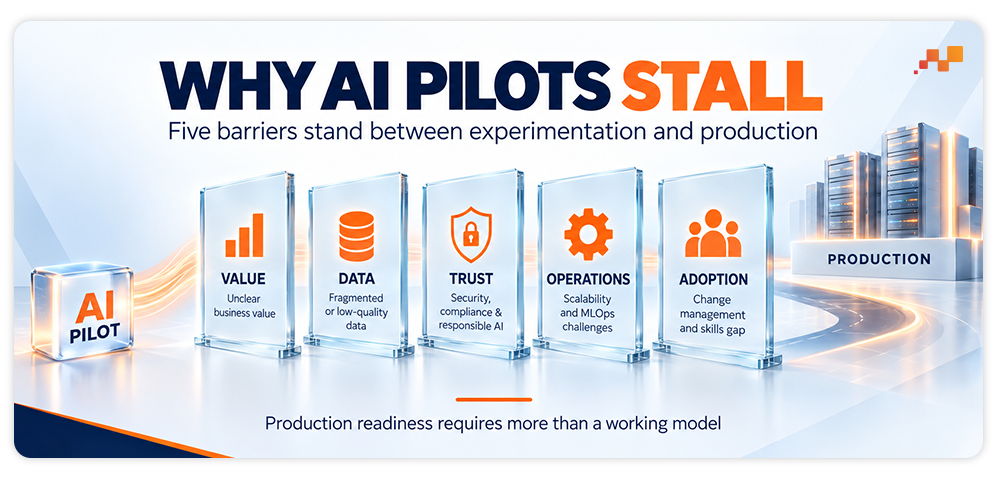
1. Unclear Business Value Ownership
The Scenario: A healthcare system launched an AI pilot for clinical note automation. The technical team measured success by inference speed (12ms per note). The finance team wanted ROI proof. Clinical leadership wanted evidence it wouldn’t introduce liability. Nobody had a shared definition of success.
After 8 months and $600K in development, the hospital couldn’t justify expansion because they’d never defined what success meant in business terms.
The Impact: This barrier alone accounts for ~40% of stalled initiatives according to Gartner’s 2025 survey[2]. Organizations that define KPIs before model selection move to production in half the time.
What Factspan Does: Our AI Business Case Development service defines KPIs before model selection. We establish shared ownership structures and track ROI continuously. Clients using our framework move to production in half the time.
2.Data Governance Gaps
The Scenario: A retail company operated separate customer data systems across e-commerce, physical stores, and loyalty programs. When they tried to build a unified recommendation engine, they discovered the same ‘customer ID’ meant three different things across systems. The project stalled for 6 months while data engineering built reconciliation logic.
Cost Impact: $1.2M in rework. 18-month delay. Solution quality compromised.
What Factspan Does: Our Data Modernization service audits your data ecosystem, establishes governance frameworks, and builds unified data platforms. We ensure data quality before AI, not after.
3. Hallucinations, Trust, and Observability Gaps
The Scenario: A financial services firm deployed an AI-powered regulatory reporting assistant. In the first week of production, it confidently recommended an incorrect tax treatment—generating a memo that went to legal review. Credibility collapsed. The system was pulled within 48 hours.
The firm didn’t have insufficient models—they had insufficient observability. They couldn’t see what the system was ‘thinking.’ They had no evaluation pipeline to catch errors before deployment. They had no audit trail for regulators.
The Cost: Lost credibility, 6-month delay while they rebuilt evaluation systems, $800K in remediation. In regulated industries, one hallucination can cost millions and destroy executive trust in AI.
What Factspan Does: Our Evaluation & Observability platform catches hallucinations before production. We implement automated quality controls, audit trails, and real-time monitoring to maintain 99%+ confidence in AI outputs.
4. Production Operations and MLOps Immaturity
The Hard Truth: Building the model is 20% of the work. Running it reliably for 3+ years is 80%.
A manufacturing company successfully trained a predictive maintenance model. It achieved 92% accuracy in the lab. But in production, they discovered:
- The model required retraining every 3 weeks as equipment aged (nobody owned this)
- Inference latency at 95th percentile was 8x higher than expected (infrastructure not sized right)
- Model performance drifted but they had no monitoring to detect it
Result: Accuracy dropped to 71% within 6 months. The system was decommissioned.
What Factspan Does: Our MLOps & Operations Framework handles deployment pipelines, continuous monitoring, model versioning, automated retraining, and failover mechanisms. Models run reliably for 3+ years.
5.Workforce Readiness and Change Resistance
The Pattern: A customer service team was given an AI tool to draft responses. 6 months later, adoption was 12%. Why? Agents felt the AI was overstepping. They didn’t trust the recommendations. They feared the tool was monitoring them for performance cuts.
Forrester’s 2025 research shows that 58% of AI adoption failures are caused by workforce resistance, not technology failure. The missing ingredient: change management + clear communication about how AI augments jobs, not replaces them.
Organizations that succeed invest heavily in change management, offer retraining programs, and celebrate early wins. They treat AI adoption as a people initiative, not a technology rollout.
What Factspan Does: Our Change Management & Workforce Enablement program builds trust through transparent communication, hands-on training, and demonstrated wins. We drive 75%+ adoption rates.
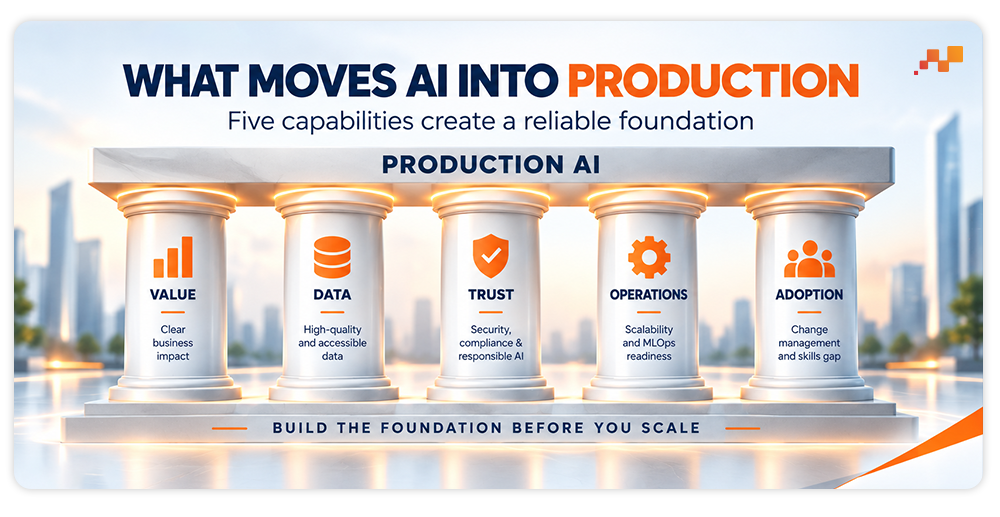
The Factspan AI Scaling Framework:
Five Capabilities That Enable Production-Grade AI
Organizations that move beyond pilots implement these five capabilities simultaneously, not sequentially. Each barrier has a corresponding capability:
| Barrier | Capability | Outcome | Timeline |
|---|---|---|---|
| Value Clarity Framework | 80% faster ROI proof | Weeks 1-4 | |
| Data Fragmentation | Unified Data Governance | 6-month deployment vs 12-month | Weeks 5-12 |
| Hallucinations | Eval & Observability | 99%+ confidence in output | Weeks 5-8 |
| Operations Readiness | MLOps & Monitoring | Models run 3+ years | Weeks 8-16 |
| Workforce Resistance | Change Management | 75%+ adoption rate | Weeks 1-ongoing |
The Path to Production: A 16-Week Implementation Blueprint
Based on our experience across 40+ implementations, organizations that move through these phases in parallel (not sequence) reach production-ready status in 16 weeks:
Weeks 1-4: Foundation Assessment & Value Clarity
- Inventory all existing AI initiatives and pilots across the organization
- Define business KPIs for your primary use case (not technical metrics—financial ones)
- Map data dependencies and governance readiness
- Assign executive sponsor and decision-making structure
Weeks 5-8: Data, Governance, and Evaluation Pipelines
- Build unified data governance framework
- Establish evaluation and observability infrastructure
- Implement hallucination/bias detection systems
- Begin initial model training/tuning with quality assurance gates
Weeks 9-14: Operations, Monitoring, and Change Management
- Deploy MLOps infrastructure (model versioning, A/B testing, retraining automation)
- Launch change management and workforce enablement programs
- Establish escalation procedures and human-in-the-loop workflows
- Conduct regulatory and security reviews
Weeks 15-16: Controlled Launch
- Pilot with early adopter group (10% of users)
- Monitor KPIs hourly; adjust systems as needed
- Scale to production if metrics confirm value thesis
What Does this Mean for Your Role?
For the CFO: Prove Financial Return
You need proof that AI isn’t a black hole for spending. Define ROI thresholds upfront. A healthcare system should measure: minutes saved per clinician × hourly rate × error reduction = annual savings. Without this, you can’t justify expansion budgets.
For the CTO: Build for Scale, Not Just Accuracy
Your primary challenge isn’t building better models—it’s building systems that run for 3+ years with defined human oversight. That means MLOps infrastructure, observability, automated retraining, and failover mechanisms. The hardest work happens after launch.
For the COO: Redesign the Workflow
AI doesn’t work in existing workflows—it requires redesigned ones. Where does a human review? Where does the system make autonomous decisions? What’s the escalation path? Organizations that redesign processes see 3x better outcomes than those that try to bolt AI onto legacy workflows.
What’s Next: The Shift to Agentic AI
By late 2026, the bottleneck in AI adoption is shifting. The challenge isn’t launching single-purpose AI tools anymore—it’s orchestrating multi-agent autonomous systems that make decisions without human intervention.
This creates new barriers: How do you monitor 10 autonomous agents? How do you ensure they don’t make misaligned decisions? What’s the human override mechanism when something goes wrong? Organizations with mature governance, clear observability, and production-ready operations today will be positioned to scale agentic AI tomorrow. Those still managing pilot chaos will be left behind.
The future belongs to organizations that can operationalize complete AI systems—not just models.
Ready to move beyond pilots? Factspan helps organizations implement the Factspan AI Scaling Framework across your organization—from business case development through production operations. Contact us to discuss how to accelerate your path from pilot to production.
Ready to move AI beyond the pilot?
Talk to Factspan about building the foundations required to scale AI reliably and responsibly.


Engineering AI Token Optimization...

Mathematical Optimization for Enterprise Decision ...

PowerCenter to IDMC: A Practical Migration Playboo...

AI Co-Engineer for the Data Engineering Lifecycle...

Building Scalable Data Pipelines with Alteryx and ...