
Engineering AI Unit Economics: A practical framework for controlling model consumption without sacrificing performance, reliability or trust
Why this blog?
AI adoption is moving faster than most organizations’ ability to control its costs. As copilots and agentic workflows add repeated model calls, expanding context and multiple tool interactions, token usage can grow without a clear link to business value. Sustainable optimization requires more than reducing token counts, it requires connecting model choice, workflow design, governance and cost to successful outcomes. The METER framework provides a practical way to measure, optimize and scale AI economics with discipline.
One principle keeps surfacing across enterprise AI programs: not every task needs the most powerful model available. If you’re rephrasing an email, classifying a routine request or extracting a standard field, a lighter, faster model may do the job just as well at a fraction of the cost. Expensive reasoning should be reserved for problems that are actually hard.
Simple enough in theory. But across many enterprise AI programs, this basic idea of matching the right tool to the right job is rarely applied with consistent discipline. The gap begins as an architectural choice and eventually appears in the budget.
Costs are growing faster than most people expected
Enterprises are moving copilots and agentic tools beyond isolated demonstrations and into real workflows. Yet leadership often struggles to answer a basic question: what does this cost us per team, per workflow and, most importantly, per successful business outcome?
That is the visibility gap, and it compounds quickly. Agentic workflows do not simply answer once. They may plan, retrieve data, call tools, evaluate results, retry failed steps and resend an expanding context. Depending on the architecture, a workflow can consume 5 to 20 times the tokens of a single completion. Anthropic has reported that agents in its data used about four times as many tokens as chat interactions, while systems using multiple agents used about fifteen times as many. The exact multiplier varies, but the direction is clear: additional autonomy creates additional consumption.
Long running sessions can amplify the effect. If each turn resubmits a larger history, a session that feels only twice as long to the user may cost several times more on the back end. This is not an automatic four times rule. It is a capacity planning scenario that depends on context growth, tool calls, retries, caching and the model selected.
IDC estimates that the world’s largest companies could face up to a 30% rise in underestimated AI infrastructure costs through 2027. The issue is not simply overspending. It is underestimating costs that conventional technology budgets were never designed to capture.
The Business Value of Every Token
Reducing tokens is useful only when the workflow still produces the required result. A shorter prompt that lowers accuracy, triggers more retries or sends more cases to human review can make the total process more expensive. The objective is therefore not the fewest tokens. It is the lowest sustainable cost per successful outcome within defined quality, latency, safety and reliability thresholds.
That unit will differ by workflow: cost per case resolved, document processed, code change accepted, customer query contained or insight delivered. The FinOps Foundation similarly recommends moving beyond raw token counts toward unit economics based on outcomes. This creates a common language for engineering, finance and business teams.
One AI cost challenge with three underlying problems
When AI spend gets out of hand, the causes tend to cluster around people, process and technology.
People. There is often no clear owner for the unit economics of a workflow. Prompting capability varies, but individual behavior is only part of the story. Product owners and engineering teams must also be accountable for routing rules, quality thresholds, context design and retry policies.
Process. Governance has not kept pace with adoption. Many organizations lack defined levels of model access, usage thresholds, evaluation gates and a shared context strategy. Spend can accumulate for months before anyone can explain which workflow created it or whether the resulting output was useful.
Technology. Model selection is rarely formalized. Teams often default to the strongest model even when the task does not require it. As of September 2026, depending on the provider, model and token type, the cost gap between tiers can be 5 to 25 times per token. Unbounded agent loops, oversized tool definitions, duplicated retrieval results and repeatedly submitted context magnify that difference.
Optimizing only one of these dimensions rarely changes the economics for long. Organizations need an operating model that connects ownership, measurement and architecture across the full lifecycle of the AI solution.
The METER Framework for AI Cost Control
This thinking is organized into five connected layers under the METER framework.
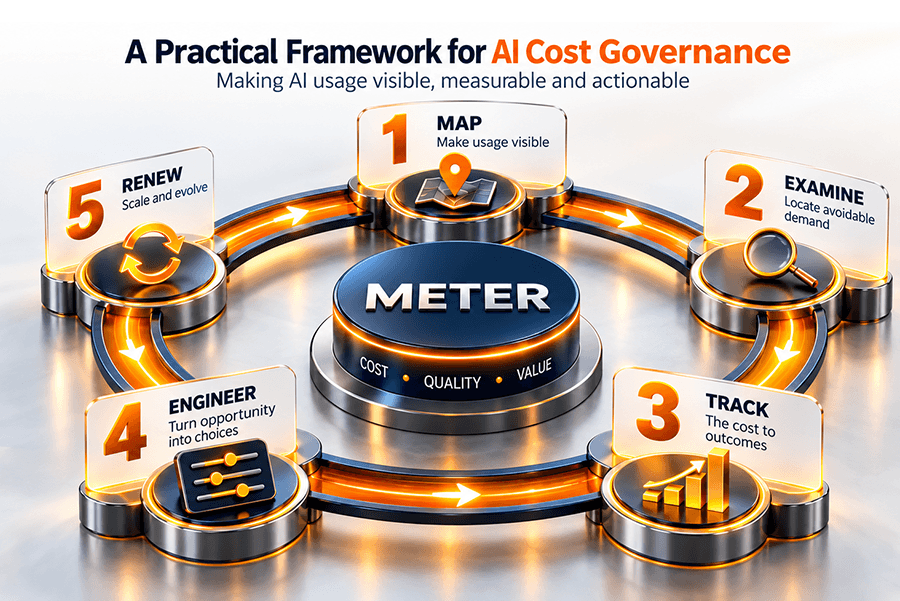
Map the spend. Establish where AI spend is occurring and connect it to the workflows and business outcomes it supports. Without that baseline, optimization becomes guesswork.
Examine the drivers. Identify the broad forces pushing cost upward, from model choice and repeated context to workflow complexity and avoidable rework. Prioritize the drivers that materially affect both cost and quality.
Track return. Activity alone does not prove that AI is creating value. Return on AI investment, or RoAI, should weigh economic value against the full cost of work enabled by AI, including model consumption, supporting technology, human oversight and rework.
Engineer the optimization. Apply the right level of intelligence to the task. Routine work may need a lighter model or deterministic handling, while complex work or work with greater risk may justify stronger reasoning. The aim is a deliberate balance of efficiency, quality and control rather than a blanket downgrade.
Renew with clarity. Use operating evidence to forecast demand and evaluate commercial commitments. A clearer view of adoption, consumption and value makes renewal decisions more disciplined and reduces the risk of buying capacity that does not match the work.
What actually drives the cost?
Total AI cost = Model consumption + Supporting technology + Human review and rework + Cost of failure
This broader view prevents token optimization from collapsing into the blunt instruction to ‘use fewer tokens.’ A cheaper response is not an improvement if it creates more corrections, delays, escalations or failures. The useful measure is the total cost of producing an acceptable outcome.
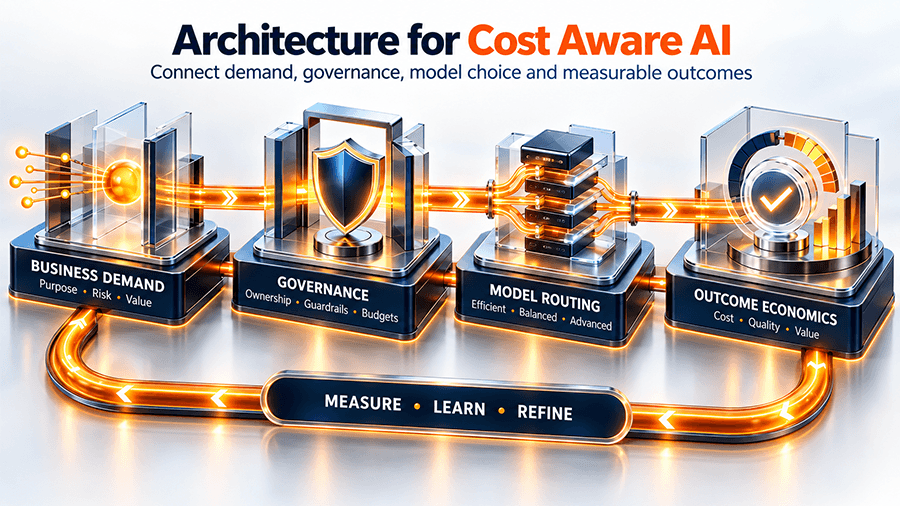
A high level architecture for cost aware AI
METER becomes practical when business workflows are connected to a common governance layer, an appropriate portfolio of models and a consistent view of outcomes. The purpose is not to prescribe a proprietary implementation. It is to show where cost, quality and accountability should meet.
The architecture is deliberately neutral across providers. Different organizations will implement these layers differently, but the governing principle remains consistent: match the level of intelligence to the task, apply proportionate controls and evaluate the result in business terms.
At a high level, this means establishing ownership and guardrails, choosing an appropriate model tier, managing unnecessary repetition and measuring whether the workflow delivered the intended result. The exact routing logic, thresholds and technical controls should remain part of the organization’s internal design.
Track return without hiding the cost of rework
Raw activity is seductive because it is easy to count. Outputs can rise while business value falls. METER therefore looks at RoAI through an outcome lens:
RoAI = Economic value created ÷ Total cost of work enabled by AI
The denominator should extend beyond tokens. It includes supporting technology, human review, correction, oversight and material rework. This is why two teams using similar tools can produce very different economics: adoption, workflow maturity and operating discipline matter as much as the model itself.
Turn optimization into unit economics
The point of METER is to denominate spend in something the business recognizes: cost per accepted output, resolved request, completed review or other successful outcome. The denominator must always carry a quality condition; otherwise, inexpensive automation may simply export its cost into rework and risk.
The goal is not to publish a universal benchmark. Unit economics vary by workflow, risk tolerance, quality requirements and operating environment. Each organization needs a baseline it can defend and a target it can measure consistently.
What does it look like in practice?
Consider an enterprise support workflow that classifies a request, retrieves an approved policy and drafts a response. A first version might send the entire conversation history, every policy document and all available tool definitions to the strongest model on every turn. It works, but the architecture pays premium rates for routine classification, repeatedly processes stable content and allows retries to grow without a clear budget.
A redesign guided by METER would first establish the cost per correctly resolved case. Routine work could use a more efficient path, while complex exceptions or those with greater risk receive stronger reasoning and greater oversight. The redesigned workflow would then be evaluated on cost, quality, latency and escalation rather than token savings alone.
This example is intentionally illustrative. The point is not to promise a universal savings percentage; it is to show that cost control comes from architecture, measurement and governance working together.
The hard part is seeing across models
Choosing a frontier model for deep reasoning and a lighter model for a routine rewrite is exactly the kind of decision teams should make continuously. But many organizations use several models from several vendors for overlapping tasks, with usage and cost data dispersed across different systems.
Visibility across models is possible, but standardizing it remains difficult. Providers describe usage and cost differently, while business teams often define success differently from engineering teams. A common measurement layer should reconcile those views without exposing sensitive prompts, proprietary routing logic or confidential workflow data.
The goal is not merely one dashboard. It is one governed measurement model that lets engineering, finance and business leaders compare cost and value across every AI workflow. The dashboard is the surface; consistent instrumentation and definitions are the foundation.
Where should enterprises start?
None of this requires tearing up what is already working. Begin with one workflow that has substantial volume or cost variation rather than attempting optimization across the entire enterprise in the first month.
- Baseline its total operating cost and define what a successful outcome means.
- Measure consumption, quality, latency and human intervention at a level appropriate for making decisions.
- Test a small set of efficiency improvements against the same quality benchmark.
- Assign an owner, a quality floor and a spend threshold, then review the unit economics regularly.
The cheapest token may be the one you never spend. But the more useful principle is this: spend the right tokens, on the right model, for a successful outcome, and make that decision visible enough to improve over time.
Optimize AI for greater value, not just lower cost. Discover a smarter path to scalable AI with Factspan.


Mathematical Optimization for Enterprise Decision ...

PowerCenter to IDMC: A Practical Migration Playboo...

AI Co-Engineer for the Data Engineering Lifecycle...

Building Scalable Data Pipelines with Alteryx and ...