
Why this blog?
As agentic AI moves into enterprise roadmaps, many organizations are grappling with where autonomy truly belongs. Applied indiscriminately, agentic architectures often add cost and fragility to workflows better suited for automation or GenAI augmentation.
This blog offers a practical lens to assess when agentic AI is the right choice, factoring in process complexity, ROI, governance, cost, and organizational readiness. It frames autonomy as a deliberate architectural decision, not a default upgrade, for leaders focused on disciplined,
long-term impact.
The Uncomfortable Truth About Agentic AI
Every pitch deck now features “agentic AI.” Every conference keynote promises autonomous systems that think, plan, and execute independently. And yet, here’s what no one wants to say out loud: most business processes don’t need agents, and forcing them in anyway is burning millions in capital and credibility.
The reality? Organizations are being sold agentic solutions for deterministic workflows that could be handled by straightforward automation or GenAI-assisted processes at a fraction of the cost, risk, and complexity. This isn’t about dismissing agentic AI’s potential, it’s about deploying it where it actually delivers measurable ROI rather than just impressive demos.
Automation vs. GenAI vs. Agentic AI
Before evaluating fit, let’s establish clear definitions:
Traditional Automation executes predefined, deterministic workflows. If-then logic, rule-based routing, structured data processing. Predictable, auditable, reliable.
GenAI-Assisted Workflows augment human or automated processes with content generation, classification, summarization, or analysis. They respond to prompts but don’t orchestrate multi-step actions autonomously.
Agentic AI observes environments, formulates plans, executes multi-step actions across tools and APIs, and self-corrects based on feedback. These systems are goal-driven, not just reactive, they make decisions, handle exceptions, and adapt without constant human direction.
The critical distinction: agents introduce autonomy, which comes with both power and risk.
Where does Agentic AI Fails in Enterprise Reality?
The promise is seductive: AI agents that autonomously optimize supply chains, route customer inquiries end-to-end, coordinate cross-system workflows with minimal human oversight. The potential for transformation is real.
But here’s the trap: industry analysts predict that over 40% of agentic AI projects will be cancelled by 2027 due to unclear business value or inadequate risk controls (Gartner). The pattern is predictable, organizations chase “agentic” because it’s trendy, not because it solves a specific, measurable problem better than alternatives.
For ROI-driven leaders, this means one thing: we must evaluate agentic AI with the same rigor we’d apply to any major infrastructure investment. The question isn’t “Is this cool?” It’s “Will this deliver measurable business value over and above what simpler approaches would?”
The Agentic AI Decision Framework
Use this six-question framework to evaluate whether an agentic approach is justified:
1. Process Complexity: Is This Actually Dynamic?
Does this workflow involve genuine variability, context-dependent decision-making, and exception handling or is it fundamentally deterministic?
Agent territory: Dynamic scheduling with real-time constraints, supply chain optimization with multiple variables, customer journeys with unpredictable paths.
Automation territory: Invoice processing, standard approval workflows, structured data entry.
Red flag: If you can map the process in a flowchart with clear decision points and predictable branches, an agent is likely overkill.
2. Value Quantification: Can You Measure the Uplift?
What specific, quantifiable business outcomes will autonomy enable that couldn’t be achieved otherwise?
Calculate expected value: labor hours saved, error rate reduction, revenue opportunities unlocked, customer experience improvements.
Threshold test: If the incremental benefit over automation + GenAI is less than 30%, the business case is weak.
3. Technical Readiness: Is Your Ecosystem Prepared?
Agentic systems require clean data across multiple sources, robust API connectivity, real-time monitoring infrastructure, and fallback mechanisms.
Reality check: If your data is siloed or your systems don’t talk to each other reliably, you’ll spend 2-3x more on integration and maintenance than on the agent itself.
4. Governance & Risk: Can You Control It?
Have you defined clear KPIs, guardrails, and oversight mechanisms? Essential controls include performance metrics, safety boundaries, audit trails, and fallback protocols.
Non-negotiable: If you can’t monitor it, you can’t manage it.
5. Cost-Benefit Reality: What’s the True TCO?
Factor in development costs (often 3-5x higher for agents), ongoing maintenance and tuning, specialized talent requirements, and operational overhead.
Decision rule: If automation + GenAI delivers 80% of the benefit at 30% of the cost, choose the simpler path.
6. Organizational Readiness: Will Your People Use It?
Is your organization culturally and operationally prepared for autonomous systems? Consider change management, trust building, exception handling, and training needs.
Common failure mode: Building brilliant technology that sits unused because the organization wasn’t ready to adopt it.
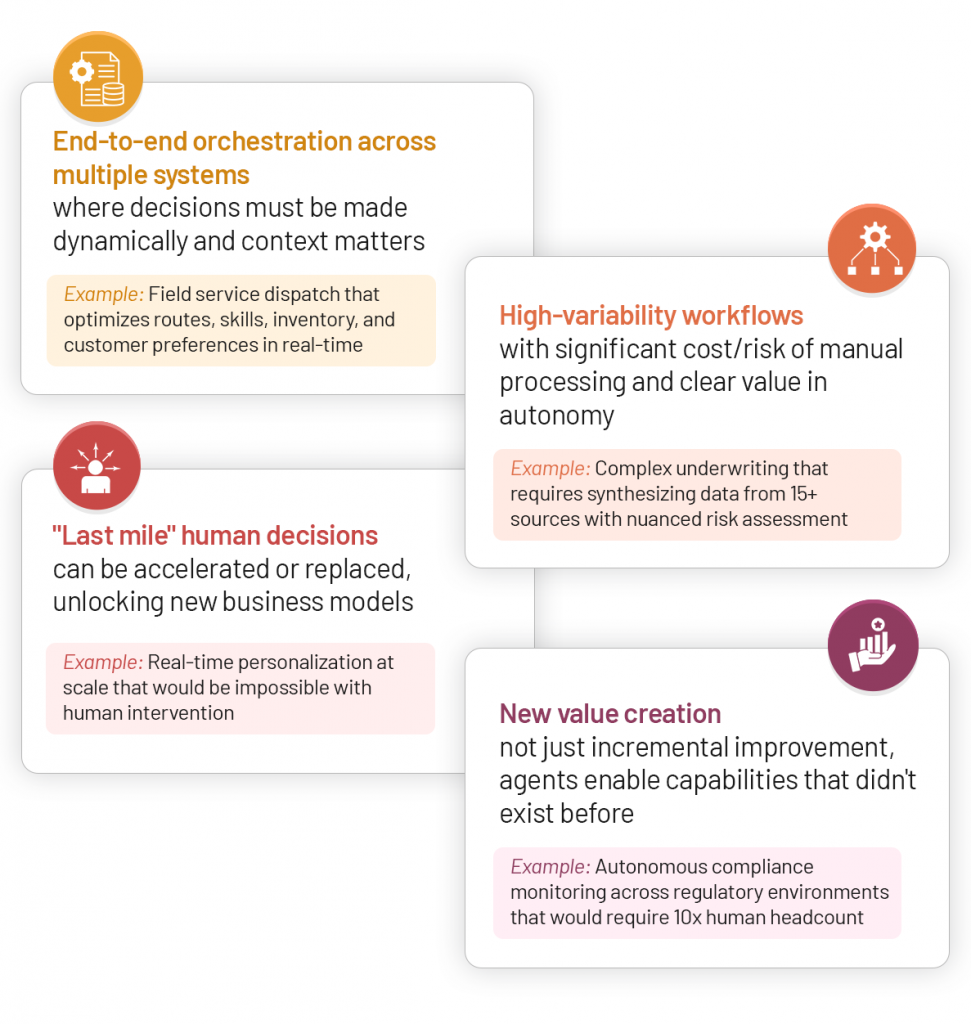
Workflows That Require Agentic Architectures
Use Cases Better Served by GenAI or Automation

Making the ROI-Driven AI Choice
Agentic AI represents genuine innovation with transformational potential, when applied to the right problems. The discipline is in knowing when to use it and when not to.
Ask yourself honestly:
- Are we solving a problem that actually requires autonomy?
- Can we quantify the value over simpler alternatives?
- Are we prepared to build and govern this responsibly?
Sometimes the smartest, most ROI-positive decision is: “We don’t need an agent, we need better automation.” And that’s not a failure of vision, it’s strategic clarity.
When you do choose the agentic path, do it because you’re unlocking measurable business value that couldn’t be achieved otherwise. Not because someone promised magic. Not because competitors are doing it. Because the numbers work and the problem demands it.
That’s how you turn hype into real business results.
At Factspan, we help enterprises cut through the noise by evaluating AI solutions through the lens of measurable impact, governance maturity, and operational readiness. Our approach prioritizes building scalable, governed, ROI-driven AI systems, whether that means automation, GenAI, or agentic architectures when the business case truly supports it.
The goal isn’t to deploy agents everywhere. The goal is to deploy them where they produce durable value.
Is your organization evaluating agentic AI?
We help you deploy autonomy only where it delivers ROI.


Mathematical Optimization for Enterprise Decision ...

PowerCenter to IDMC: A Practical Migration Playboo...

AI Co-Engineer for the Data Engineering Lifecycle...