
Why this blog?
Most enterprise AI initiatives hit a wall because they depend too heavily on a single LLM or a standalone agent system. This blog explains why Fractional AI, a task-optimized and highly composable architecture, offers a more reliable and cost-efficient foundation. It helps leaders understand how fractions, GenAI reasoning, and agentic orchestration work together to deliver scalable automation, strong governance, and rapid time-to-value across industries.
As enterprises accelerate their shift toward AI-driven operations, a clear trend is emerging: Large, monolithic AI models alone cannot deliver the reliability, scalability, or governance that complex organizations require. Modern AI systems need to be modular, composable, and orchestrated across diverse data environments.
This is where Fractional AI is gaining momentum, an architectural approach that assembles AI capabilities as specialized, interoperable intelligence units (“fractions”), enabling high-performance GenAI workloads and robust agentic automation at enterprise scale.
What Is Fractional AI?
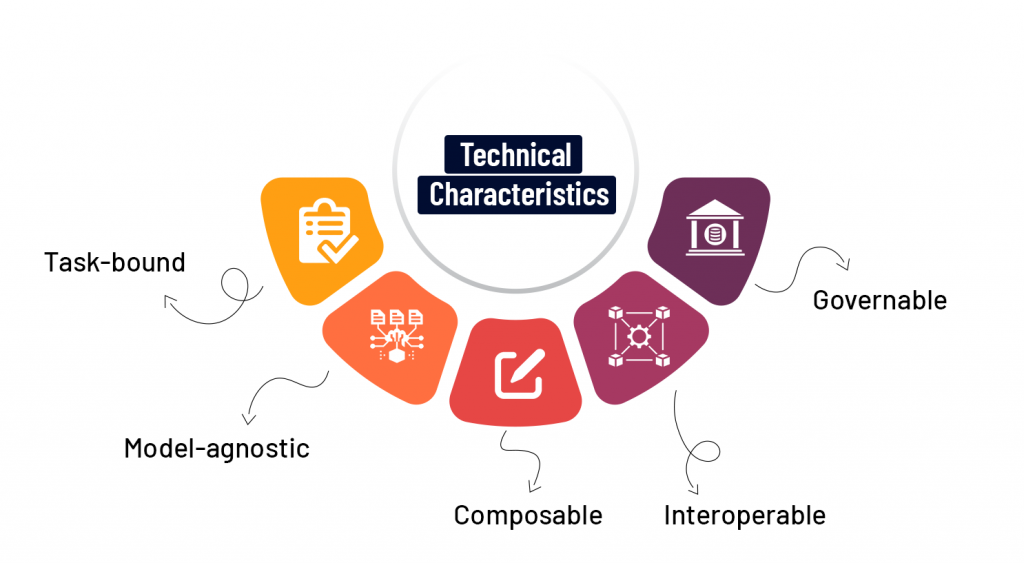
Fractional AI is an AI systems architecture in which intelligence is decomposed into small, task-optimized “fractions” rather than relying on a single, large model to handle everything end-to-end.
Each fraction is a standalone, callable, compute-bounded micro-model, function, or agentic capability that performs one specific operation with high accuracy and low cost.
These fractions may include:
- LLM-powered tasks: summarization, SQL generation, intent classification
- ML micro-models: churn scoring, forecasting, anomaly detection
- Vision models: OCR, document parsing, image classification
- Tool functions: data cleaning routines, quality checks, code linting
- Agentic sub-routines: planning, routing, error correction
- Knowledge services: vector search, ontology lookup, domain rule evaluation
Benefits:
- Predictable behavior (fractions have fixed responsibilities)
- Higher accuracy (validated reasoning)
- Lower hallucinations (guardrail fractions)
- Faster inference (fractions executed selectively)
- Modular & reusable components (domain fractions, reasoning fractions, tool fractions)
Examples of fractions:
- Retrieval Fraction
- Policy / Governance Fraction
- Domain Reasoning Fraction
- Quality Assurance Fraction
- Summarization Fraction
- Validation & Safety Fraction
- Mathematical Reasoner Fraction
How Fractional AI Differs From GenAI and Agentic AI
| Aspect | Fractional AI | GenAI | Agentic AI |
| Nature | Architecture / approach | Model capability | System of agents |
| Purpose | Modular, task-specific AI blocks | Generate content | Autonomously perform tasks |
| Reusability | Very high | Moderate | High |
| Granularity | Fine-grained | Broad, general | Mid to high granularity |
| How they connect | Fractions can power GenAI tasks or be orchestrated by agents | A GenAI model may serve as one “fraction” | Agents can chain multiple fractions |
Generative AI (GenAI)
GenAI models handle reasoning, text generation, conversation, and multimodal tasks but using an LLM for everything is expensive and harder to govern. Fractional AI complements GenAI by offloading task-specific work to smaller, optimized components.
Agentic AI
Agents can plan, reason, call tools, and validate outputs autonomously. Fractional AI provides the capability layer these agents depend on, enabling reliable multi-step automation.
How Fractional AI, GenAI, and Agents Work Together

Why Fractional AI Matters for Enterprise AI Adoption:
- Cost efficiency
- Higher accuracy through specialization
- Reusability across use cases
- Strong governance and observability
- Faster deployment cycles
Real-World Enterprise Use Cases:
- Pharma & Healthcare: PA automation, digital adoption scoring, clinical summarization
- Retail & CPG: forecasting, segmentation, enrichment, merchandising copilots
- Insurance: claims triage, FNOL extraction, underwriting enrichment
- Logistics: workload predictions, exception management, billing automation
- Entertainment: customer 360, personalization, NPS routing
The Enterprise AI Stack:
- Data Layer
- Intelligence Layer (Fractions)
- Orchestration Layer
- Experience Layer
Why Enterprises Are Moving Toward Fractional AI
1. Composability and Reuse
Companies don’t want to rebuild the same AI capability 20 times across teams. Fractions can be reused across use cases like:
- Data engineering
- Customer analytics
- Finance reporting
- Supply chain forecasting
- Marketing automation
2.Multi-Model Strategy
One model rarely fits all needs. Fractional AI lets teams choose the best model per task — open-source, proprietary, small model, or LLM.
3. Cost and Performance Optimization
Activating only the required fractions dramatically reduces inference cost and latency.
4.Easy Governance and Monitoring
Each fraction has a defined purpose. This makes compliance, auditability, and version control simpler.
5. Faster Time-to-Value
Presales teams can assemble solutions quickly using pre-built fractions, accelerating PoCs and client conversion.
How Fractional AI Works With Agentic AI
Agentic systems thrive when they have a reliable set of capabilities. Fractional AI provides this backbone.
An agent can:
- Plan – break down a task
- Select fractions – pick the needed modules
- Act – execute steps
- Self-correct – validate using other fractions
- Complete – deliver the result autonomously
This layered approach results in enterprise-ready, autonomous, scalable AI systems.
Where is Fractional AI Creating Impact Today?
Industries adopting Fractional AI include:
- Healthcare: automated document processing, patient summaries, clinical coding
- Retail: demand forecasting, personalization, supply chain analytics
- Finance & Insurance: claim processing, risk scoring, compliance automation
- Logistics: route optimization, exception handling
- Entertainment & Hospitality: customer insights, guest experience personalization
Pharma: digital adoption measurement, refill prediction, HCP analytics
The Future is Fractional Intelligence + Agentic Automation
Fractional AI isn’t replacing GenAI or Agentic AI, it’s connecting them.
- GenAI provides creativity and reasoning.
- Agentic AI provides autonomy.
- Fractional AI provides structure, modularity, and operational efficiency.
Enterprises that adopt all three will move the fastest toward full-scale AI transformation.
Fractional AI is emerging as the foundational architecture for enterprise AI as modular, composable, efficient, and infinitely scalable. As Generative AI evolves and agents become more autonomous, Fractional AI will serve as the glue that holds these systems together.
If GenAI is the brain and agents are the workers, Fractional AI is the toolkit that powers the entire ecosystem.
Ready to build enterprise AI systems that are modular, governable, and built for long-term scale? Let’s talk.


Multi-Agent Healthcare Ecosystems for Smarter and ...

Enterprises are Turning to Compact Models in AI...

Tackling E-commerce Catalog Complexity with Genera...


Analytics Unplugged: Navigating The Tension Betwee...

AWS Data Engineering Essentials Guidebook...

Unveiling Insights: Checking File Trend Analysis f...

FAQs on Data Engineering Services...

A Blueprint on Data Engineering Services...