
Why this blog?
For years, Large Language Models have dominated headlines, but not every problem needs a trillion-parameter solution. This blog unpacks why smaller, domain-tuned models are outperforming their larger peers in speed, cost-efficiency, and real-world adaptability. You’ll discover how SLMs are powering faster deployments, explainable AI, and on-device intelligence, making AI more practical, responsible, and accessible.
In the world of AI, we’re of the opinion that the bigger the better. From the mainstream GPT models with billions of parameters to the eye-watering cost of training large-scale transformers, size has been the defining feature of state-of-the-art language models.
But is size really the secret sauce to better performance, or are we missing something more crucial about the future of language models?
Enter small language models 🡪 SLMs break the chain of thought that has been fed: that size is equated to performance. But how is it that smaller models, with their limited parameters, outperform their bigger peers in specialized applications
Let’s break this down!!
The Case for Small Language Models
SLMs don’t have the extravagant size of GPT-3 or GPT-4, but they bring unique advantages to the table. Whether it’s in resource-limited environments, real-time applications, or specific domain tasks, these models have proven that size isn’t the ultimate determinant of success.
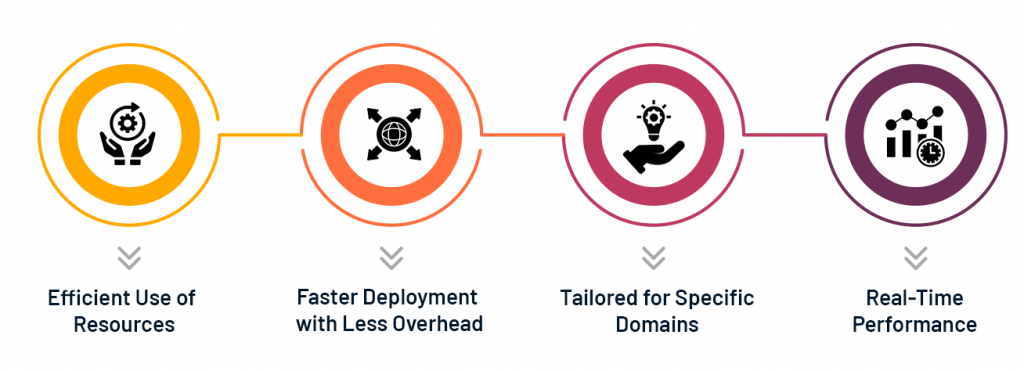
1. Efficient Use of Resources
One of the most compelling reasons to embrace small language models is efficiency. LLMs demand massive computational power and substantial energy resources for training and inference. SLMs, by contrast, run on minimal resources, making them ideal for edge devices, mobile apps, and real-time processing environments where latency & cost are critical
A smaller model size means that AI systems require lesser investment in hardware, use less power, and enable quicker results. This forms the basis of scalability and cost-effectiveness required in industries for the deployment of AI systems.
2. Faster Deployment with Less Overhead
In fact, training large language models can take weeks or months. Once they are trained, their deployment is cumbersome, involving specialized infrastructure & storage. SLMs can be trained in a fraction of the time, making them ideal for companies looking to iterate quickly or rapidly adapt to new data.
3. Tailored for Specific Domains
Probably the most underestimated advantage of small language models is their capability for specialization. Whereas GPT-4 type of models are generic and excellent generalists, smaller models can be honed to do very well in narrow, specific domains. Small models can be fine-tuned to understand domain-specific terminologies, contexts, and nuances.
4. Real-Time Performance
Speed does matter, especially in applications that require real-time processing. Small models have fewer parameters and are usually faster to generate predictions or process input data; so, they are perfect for applications in industries like customer service chatbots, where responses are needed in real time, or fraud detection systems.
The Truth About Size and Intelligence in AI
While LLMs are undoubtedly great at many different things because of their enormous scale and capability to handle knowledge, one does need to remember that size isn’t everything; it might not provide additional effectiveness with respect to specific usage scenarios.

1. Task-Specific Efficiency
For many applications, a smaller model can be more efficient than a large model. Though larger models have a higher overall accuracy on a wide variety of tasks, they often show diminishing returns when applied on specific domains. Smaller models can be fine-tuned on a smaller dataset and still yield very accurate predictions using a fraction of the resources. Also, smaller models are less liable to overfitting when the training is proper, mainly when the problem space is clearly defined.
2. Transfer Learning: Big Benefits Come in Small Packages
Major innovation in the area of AI over recent times has been transfer learning, the concept of taking a pre-trained model and fine-tuning it for specific tasks with a smaller dataset. This is where small models shine. With the power of transfer learning, small models can leverage knowledge gained from large models and adapt it to create niche applications. Consequently, they can perform at levels comparable to larger models within their niche, without the large computational expense.
3. Interpretable and Explainable AI
With the growing demand for explainable AI (XAI), smaller models have a distinct advantage. Larger models are often seen as “black boxes” due to their complexity. Smaller models, are easier to interpret, making them more transparent and explainable.
For sectors like healthcare, finance, and law, where AI decisions can have profound impacts, being able to explain the reasoning behind model predictions is critical. Smaller models, with their more compact architecture, are better suited for building trust and meeting regulatory requirements around explainability.
Looking at Real Deployment Wins Powered by Small Models
While large language models are all the rage, many industries are already seeing the practical benefits of small models. For example:
- Healthcare: A small model trained to detect specific medical conditions can outperform a large general-purpose model in diagnostic accuracy, using less data and requiring less computational power. These models can be embedded in medical devices and smartphones for real-time diagnostics.
- Finance: Financial forecasting can be done using smaller models on transaction data and will often provide faster, more accurate predictions than larger models, especially when that data is structured and domain-specific.
- Customer Service: Small models built to perform a specific function in customer service can handle queries more accurately, sometimes even faster than big models that try to generalize across many industries.
The Value of Small Models Lies in their Practicality
Of course, SLMs aren’t a silver bullet. Their compact size inherently limits their general knowledge, contextual depth, and creative reasoning. Large models still dominate in open-ended conversations, complex summarization, or reasoning across vast domains of knowledge.
Smaller models may also require careful fine-tuning and data curation to achieve competitive performance and without high-quality, domain-specific datasets, they risk underperforming or overfitting.
The key, then, isn’t to replace LLMs with SLMs, but to strategically blend them — using large models for discovery and small models for deployment.
Small Models Delivering Results in Operational Workflows
The future of AI is not about what model has more parameters; rather, it is about which one can deliver value in the shortest time while being accurate and responsible. Small language models are poised to be a key part of this future, enabling businesses to deploy highly specialized, efficient, and scalable AI systems.
For companies looking to make AI accessible, scalable, and affordable, small models offer an incredible opportunity to innovate and compete in a world where size doesn’t always matter. In fact, when it comes to language models, the real strength lies in being lean, focused, and efficient.
Ready to make your AI leaner, faster, and smarter?


Fractional AI and the Future of Enterprise GenAI S...

Multi-Agent Healthcare Ecosystems for Smarter and ...

Tackling E-commerce Catalog Complexity with Genera...


Analytics Unplugged: Navigating The Tension Betwee...

AWS Data Engineering Essentials Guidebook...

Unveiling Insights: Checking File Trend Analysis f...

FAQs on Data Engineering Services...

A Blueprint on Data Engineering Services...