
Why this blog?
Most healthcare AI still works in silos, creating limited impact despite heavy investment. This blog explains why coordinated, multi-agent ecosystems offer a more scalable and practical path forward by enabling real-time collaboration across hospital functions. It helps leaders understand the architectural, operational, and governance considerations needed to build truly intelligent hospital systems.
Healthcare organizations in the U.S. face a severe optimization challenge, with over $400 billion lost annually to administrative complexity and
care-delivery failures (JAMA), while simultaneously confronting a projected shortage of 124,000 physicians by 2034 (AAMC).
While single-purpose AI models achieve narrow task automation, the real transformation opportunity lies in multi-agent architectures, distributed systems where autonomous agents leverage large language models, retrieval-augmented generation (RAG), and reinforcement learning to coordinate complex workflows across clinical and operational domains.
Why Healthcare Needs Collaborative Agentic AI Now
Siloed AI implementations create technical debt and integration challenges. A standalone computer vision model for radiology operates in isolation from hospital information systems (HIS), electronic health records (EHR), and resource management platforms, creating latency in care delivery and information asymmetry across departments.
Hospitals implementing coordinated AI systems report significant reduction in readmission rates , improvement in emergency department throughput,
and significant annual savings per. Multi-agent systems address healthcare’s fundamental challenge, managing interdependent workflows where decisions cascade through multiple systems and stakeholders.
What Is a Collaborative Agentic AI Ecosystem from Healthcare POV?
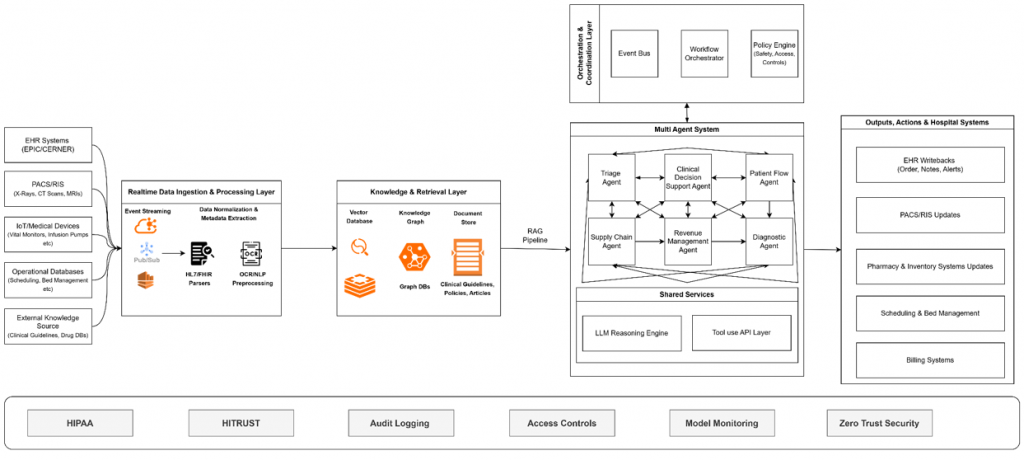
A multi-agent healthcare ecosystem is a distributed architecture where specialized AI agents, each powered by domain-fine-tuned foundation models, operate autonomously while maintaining semantic interoperability through a message-passing framework. These agents employ chain-of-thought reasoning, tool-use APIs, and multi-modal processing to handle tasks from clinical documentation to supply chain optimization.
Below architecture gives a view of what a Multi Agentic implementation within Healthcare setting looks like:
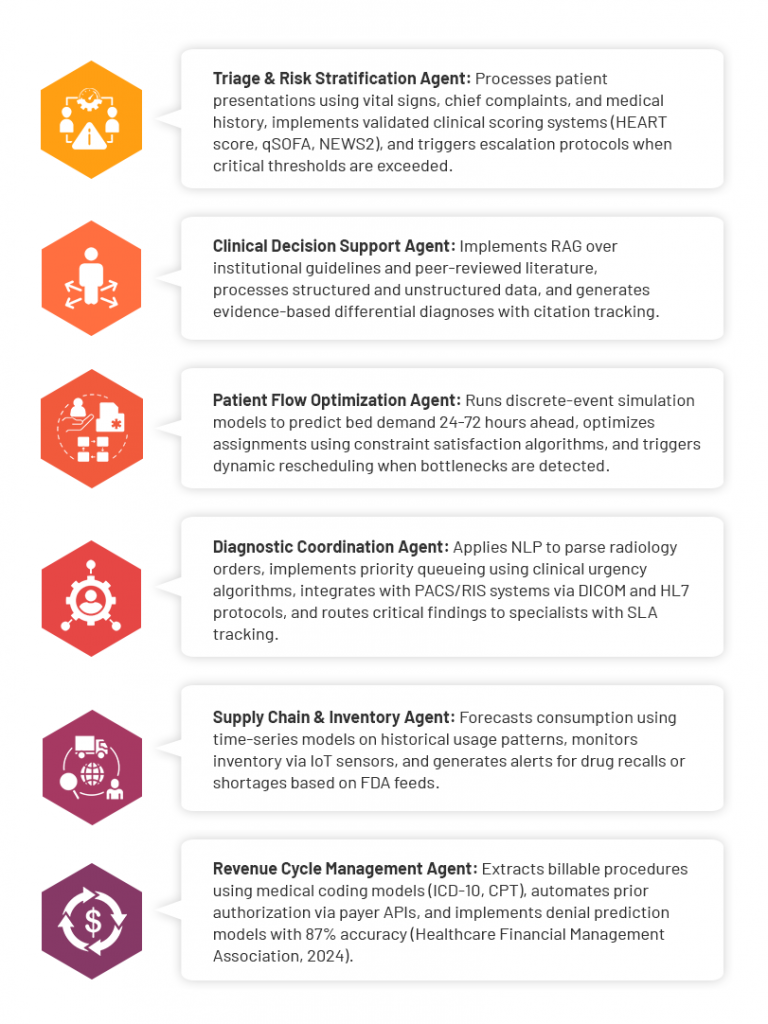
Key AI Agents That Power a Smart Hospital
How These Agents Collaborate in Real Time
Consider a 68-year-old patient with acute chest pain and elevated troponin:
Triage Agent processes vitals, runs HEART score calculation, publishes high-acuity event to message bus
- Diagnostic Agent prioritizes stat ECG and troponin series, reserves cardiac catheterization slot conditionally
- Clinical Decision Agent retrieves patient context from EHR FHIR endpoints, identifies contraindications, generates treatment protocol with ACS guidelines
- Patient Flow Agent identifies available ICU bed, notifies interventional cardiology team
- Supply Chain Agent verifies heparin, clopidogrel availability, alerts pharmacy for medication preparation
- Revenue Cycle Agent initiates real-time eligibility verification, pre-authorizes catheterization procedure
This orchestrated response occurs in under 180 seconds, with each agent maintaining decision logs for retrospective analysis.
Business & Clinical Impact Hospitals Can Expect:
- Increased Operational Efficiency – Reduction in Average length of stay, Decrease in Patient boarding time, Administrative Time saving
- Improved Clinical Outcomes – Early detection of critical illness, Reduced Medical Administrative errors, Improvement in Guideline adherence for chronic disease management
- Improved Financial Performance – Reduced claim rejection rate, Improvement in PA Approvals, Reduced Supply chain costs
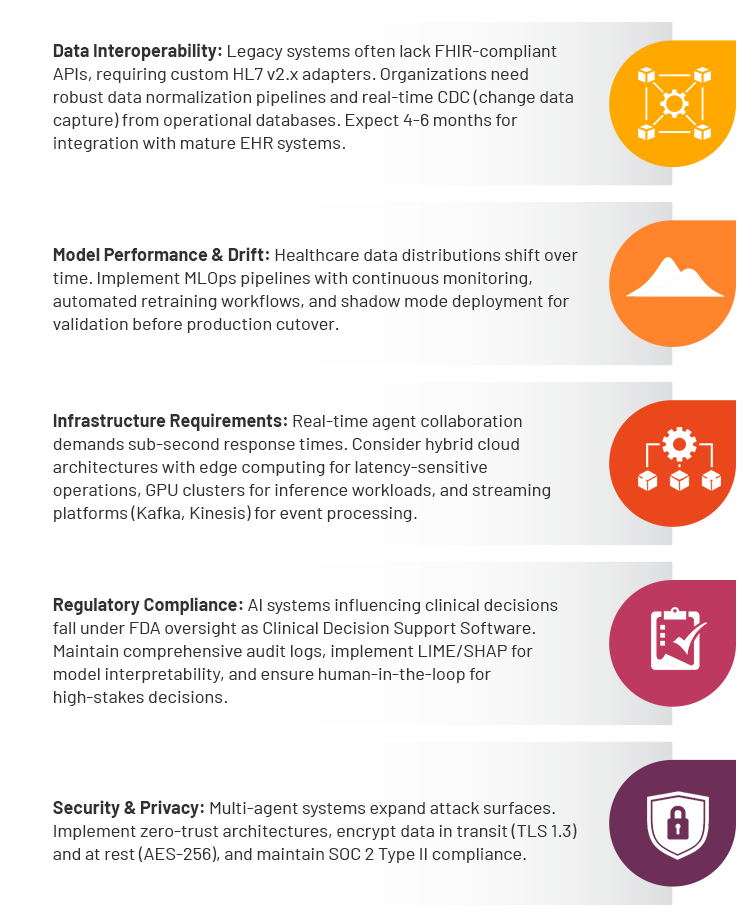
Challenges and What Leaders Should Prepare For
How Factspan Can Help?
Factspan brings deep expertise in designing and deploying production-grade multi-agent AI systems for healthcare organizations.
Assessment & Strategy: We conduct comprehensive technical assessments of your existing infrastructure, identify high-impact use cases through clinical workflow analysis, and develop phased implementation roadmaps aligned with your operational priorities.
Custom Agent Development: Our team builds domain-specific agents fine-tuned on your institutional data, implements secure integration with Epic, Cerner, and other platforms via HL7/FHIR standards, and deploys RAG systems connected to your clinical knowledge bases.
Orchestration & Integration: We architect scalable orchestration platforms using event-driven microservices, implement real-time data pipelines with sub-second latency requirements, and ensure seamless interoperability across your clinical, operational, and financial systems.
MLOps & Governance: Factspan establishes monitoring frameworks for model performance and drift detection, implements automated retraining pipelines with clinical validation workflows, and builds comprehensive audit trails meeting HIPAA and FDA compliance requirements.
The healthcare AI transformation is about orchestrating intelligent systems that collaborate as seamlessly as your clinical teams. Organizations that architect multi-agent ecosystems now will establish sustainable competitive advantages in quality, efficiency, and financial performance.
Ready to architect your multi-agent AI ecosystem? Contact Factspan to discuss how we can accelerate your healthcare AI transformation.
Ready to build a hospital where AI systems collaborate as seamlessly as your clinical teams?


Enterprises are Turning to Compact Models in AI...

Tackling E-commerce Catalog Complexity with Genera...

Analytics Unplugged: Navigating The Tension Betwee...

AWS Data Engineering Essentials Guidebook...

Unveiling Insights: Checking File Trend Analysis f...

FAQs on Data Engineering Services...

A Blueprint on Data Engineering Services...