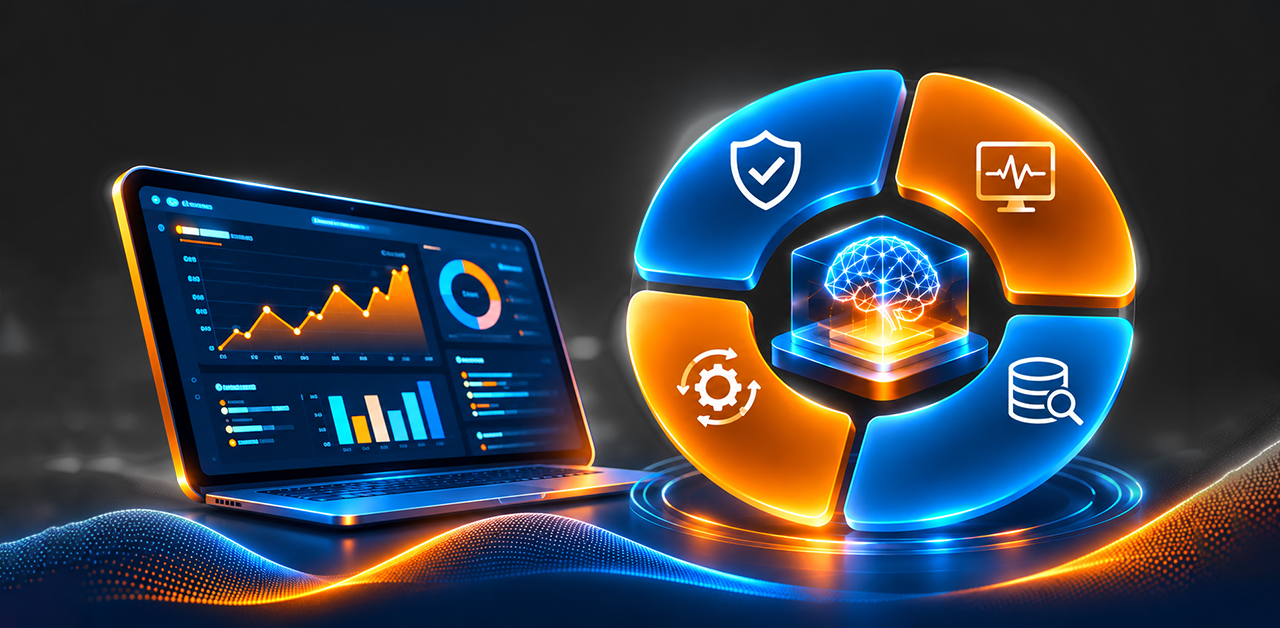
Production Readiness and Intelligence
Deployment is not the end of the ML lifecycle. Four additional agents help teams improve production readiness, monitoring, failure recovery and model understanding—turning production from a leap of faith into something teams can govern, watch, fix and explain.
INTELLIGENCE
Four questions that begin when the model goes live.
A model deployed is not a model finished. Once it heads to production, the questions change—and so does the kind of help teams need.
Standards are easy to document. Hard to enforce.
Every production implementation is expected to follow engineering and deployment standards. Checking each repository the same way, every time, is the hard part.
Before the Compliance Agent
- Reviewers manually dig through the repository for each control.
- Different reviewers read the same implementation differently.
- Evidence is scattered across files.
- Developers receive findings without seeing the code behind them.
With the Compliance Agent
- Automated repository-level validation against defined standards.
- Every finding states what failed, why, where and how important.
- Concise root cause, severity and evidence replace generic output.
- Human review focuses on exceptions and judgment.
Inside the agent
Controls covered
Jenkins configuration, requirements and dependencies, Vertex configuration, exit handlers, Pub/Sub integration, parameterization, deployment configuration.
Evidence-based findings
Each finding answers: what failed, why it was flagged, where the evidence is, how important it is and what the developer should inspect.
Checklist to assessment
Feedback shaped verbose output into concise root causes, severity levels, subfolder exclusion and less noise.
Deploying a model is easier than watching it well.
A model can work on launch day and still degrade as inputs change, distributions drift and KPIs move. Monitoring used to be a separate engineering project for every model.
Before the Monitoring Agent
- Decide baselines, columns, thresholds, outputs and alerts from scratch.
- Implement data analysis, drift, metrics, KPIs and alerting by hand.
- Common architecture rebuilt for every project.
With the Monitoring Agent
- The agent discovers training and scoring tables, model location, features and target columns.
- A standardized framework is added around the existing repository.
- Teams start with a working implementation and customize it.
| Capability | What it does |
|---|---|
| Data analysis | Profiles input data: distributions, feature summaries, categorical and continuous statistics. |
| Input drift | Compares baseline and current features: PSI and KS for continuous, Chi-Square and Cramér’s V for categorical. |
| Model metrics | Where actuals exist, loads the model, generates predictions and computes metrics suited to the model type. |
| Output drift | Detects prediction shifts even when inputs look stable. |
| Business KPIs | Customizable measures such as response rate, conversion, coverage or volumes. |
| Alerting | Evaluates all signals; a master step summarizes whether intervention is needed. |
TRAIN / TEST tables     ACTUAL_COL       PREDICTION_COL
MODEL_ID                MODEL_TYPE       COLUMNS_TO_EXCLUDE
SAMPLING_RATE           Drift thresholds Metric thresholds

RUN_DATA_ANALYSIS  RUN_INPUT_DRIFT  RUN_MODEL_METRICS
RUN_OUTPUT_DRIFT   RUN_BIZ_KPI      RUN_ALERTING
Modular by design
Every capability has a toggle. Model A can run all six; Model B can skip metrics and KPIs when it has no ground truth yet.
Config, not rewrites
Model-specific behavior lives in configuration, so the framework stays standard while teams tune thresholds.
The error you see is rarely the cause.
Failures originate in application logic, dependencies, IAM, registry access, missing libraries, pipeline parameters or model artifacts. Many of them repeat from project to project.
Before the Auto-Heal Agent
- Open logs, find the failed component, read the stack trace.
- Inspect the repo and configuration, search past issues.
- The same permission, dependency and parameter problems feel new every time.
With the Auto-Heal Agent
- Failure context is collected and matched to known patterns.
- The agent correlates logs with repository and configuration.
- A probable root cause and fix are proposed, or applied when low-risk.
- Resolved incidents become reusable knowledge.
Inside the agent
Contextual analysis
A bare PermissionDenied is not enough. The agent works out which component failed, which resource it touched and which service account ran it.
A learning loop
Failure, diagnosis, root cause, resolution, reusable pattern, future detection.
Human in the loop
Low-risk deterministic fixes can be automatic; higher-risk changes arrive as a recommendation for the engineer to approve.
Understanding someone else’s model takes time.
The person debugging or monitoring a model often is not the person who built it. Notebooks, modules, SQL, config and pipelines all have to be pieced together.
Before the Model Insights Agent
- Read the README, then config, pipeline, components and SQL.
- Trace training and scoring by hand.
- Build a mental architecture before doing any real work.
With the Model Insights Agent
- The agent discovers files, config, data, features, model and pipeline.
- Engineers get a structured overview first.
- They then inspect only the components that matter.
| Area | What the summary covers |
|---|---|
| Business and model context | Purpose, prediction target, model type, training and scoring flow |
| Data | Input datasets, BigQuery tables, SQL queries |
| Feature engineering | Generation functions, feature groups, categorical vs. continuous, excluded columns |
| Model implementation | Algorithm, model artifact, training and prediction stages |
| Pipeline architecture | Components, execution sequence, parallel stages, dependencies, submission logic |
| Configuration | Project IDs, datasets, buckets, model paths, pipeline names, runtime parameters |
Governance, observability, reliability, understandability.
Four qualities of a production ML system, each owned by one agent.
| Agent | Primary question |
|---|---|
| Compliance | Does this meet the required production standards? |
| Monitoring | How do we know the model and its data still behave as expected? |
| Auto-Heal | What caused this failure and how do we fix it faster? |
| Model Insights & Summary | What does this repository and model actually do? |
All eight agents, one lifecycle
Infrastructure runs models. Intelligence helps teams run them well.
ML platforms have focused on compute, storage, orchestration, registries and pipelines. That remains essential, but infrastructure alone cannot say how to transform a repository, whether it is compliant, how to monitor it, why it failed or what it does. FMD adds that layer—encoding the repeatable parts of engineering expertise so experts stop solving the same problems.
Faster deployment. Consistent operations. Reusable knowledge.
Explore the Fast Model Deployment series.
Follow the journey from model development to production-ready deployment and intelligent operations.
Turn working models into production ready systems.
Talk to Factspan about your next deployment.

Fast Model Deployment · Part 2 Building the Deplo...